Hello friends,
Recent tropical rains here in Colombia flooded the city we are in; roads became rivers and Ryan and I needed to hold hands to support each other when crossing the streets in order to fight the currents and standing waves. We wondered at the parasites and tropical diseases we could have picked up while wading through the thigh-high waters in this tropical, developing city. And yet I knew that this was nothing compared to what it would look like if we were in Haiti. Only an hour's flight away yet worlds apart.
Of course my mind came back to cholera. Spread through the water, this bacteria sneaks its way into your food, your bathing, your water. And creates mayhem. No cholera here in Colombia, and if there was it would be well-treated and controlled. People have access to clean water everywhere, even in the thick dense jungle.
But in Haiti it is different; the cholera treatment centers are struggling still with staffing levels, supplies, and rising numbers of patients. Reports keep coming in from various isolated communities in the north of patients dying en route, being turned away by hospitals ill-equipped to deal with cholera, or having not enough money to pay for the five cent fare to make it to any centers. Even the centers staffed by our own teams are fighting to stay abreast of the chaos; exhausted from working too much and frustrated by constant deaths and not enough resources, the medical staff are tiring, and people continue to die. It is thankless work, let me tell you, but they still need your help.
Cholera has reached port-au-prince and is quickly grasping hold of the worst slums. For some reason I thought the numbers wouldn't be bad in the capital; I was wrong. The numbers are climbing daily, and the statistics point to a constant increase. Many more will die, and more still will be infected. Estimates say 200,000 deaths will result from this outbreak, and we are only at 1300 at present. It is so sad, and so brutal, because this disease is so treatable. IF you get to the hospital in time. IF the hospital will take you in. And IF the hospital that takes you in then has access to the right resources and staffing levels. Resources are not much; all you really need is a constant supply of IV fluids, IV supplies, and diapers. Yet somehow it has been a challenge to supply most of the CTC with these items.
Please take the time to read this graphic but honest blog on cholera in Haiti's capital:
http://goatpath.wordpress.com/2010/11/22/cholera-reaches-port-au-prince-as-victims-are-left-in-mass-graves/
And please, in this holiday season, consider making a donation to Partners in Health, towards cholera treatment. They run many of the CTCs in the north, and have been present in Haiti for decades. They know the country, its people, and how to fight this battle. You can donate here:
https://donate.pih.org/page/contribute/donate
If you haven't already done so, please take the time to read my recent post "Love in the time of cholera". You will get a good idea of what it is like to work in a CTC.
Thank you all for your continued love and support; this means so much to me, and it pains me to see all the suffering in my cherished Ayti. Much much love from me.
Friday, November 26, 2010


Wednesday, November 17, 2010
Life in the time of cholera
Mirebalais Cholera Treatment Center; November 14
Shift 6 at the CTC (Cholera Treatment Center); my team has covered 1600-0800 in two eight hour shifts here at the PIH CTC here in Mirebalais. Set amidst the rolling greenery of the Haitian countryside, this treatment center is hydrating and treating upwards of 150 patients a day, one by one by one.
Cholera spreads through the water, and recent heavy rains from Hurricane Tomas exacerbated the spread of the bacteria. People bathe and drink the water from the river, and campaigns to drink and bathe in "dlo pwop" -clean water- have accelerated across the country. Unknown in Haiti for the past 50 years, cholera is thought to have been brought in by the Nepalese UN contingent, and recently UN forces have been subject to violent riots due to this epidemic. Cholera is already beginning to be stigmatized; we watched the Haitian nurses don masks and caps before entering the cholera tents, and although you cannot catch cholera through the air (or your hair), the lack of education and familiarity with the illness results in this fear.
We show up to work after we bleach our arms and shoes, are given our disposable scrubs (or biohazard suits when we run out of scrubs), booties to cover our shoes, then bleached again, and corralled into the "cholera tent". Our team, 5 nurses and 1 nurse practitioner from Vancouver, 1 logistician, and 2 translators, has worked in this tent nightly for the past 5 nights, treating patients of all ages, from the very young to the very old. The treatment is simple, basic, easy. Almost to the point of being mindless and boring. But the results are immeasurable.
Patients come in close to death, dehydrated beyond belief, limp figures on stretchers or in their parents' arms, having lost all fluid in their body through vomit and diarrhea. We often struggle to find veins, poking them many times before getting a decent line in. The more severe cases we ask the doctors to insert an IV straight into the jugular. And then many liters of fluid later, we discharge them home; alert, eyes open, and looking so much better.
One patient stands out to me. She was admitted at 5:30 in the morning, a lifeless girl of 9 years, skinny and malnourished, and completely limp. We poked and prodded so many times, trying desperately to find a decent vein, failing even her jugular. She lay there completely disinterested and unaware of the pain we were causing her. Eyes rolled back. Reddenned hair: kwashiorkor- sign of malnutrition. No family with her. One leg significantly thinner than the other- "polio?" our Nicaraguan doctor wondered. We are strictly a cholera treatment center, nothing else, a fact that frustrates us often due to the lack of any other resources. No diagnostic tools other than two blood pressure cuffs, the stethoscopes around our necks, and a handful of thermometers. No emergency equipment. The doctor motions for me to get the ambubag. I look at him, eyebrows raised- we have no resuscitation equipment; the last time someone was resuscitated he placed a mask on the 9 month old on and gave mouth to mouth through the vomit. The baby died; no one was able to get a line in. He runs over to the desk and pulls out his own asthma spacer and mask: "we can use this if she needs it". An improvisation. Then, as we continue to poke her, looking desperately for a vein: "Go get the epinephrine. But don't break it [the ampule] yet." Resources are scarce, and we only have a few precious vials of epi. Finally the other doctor gets a line in her jugular, and we all breathe a sigh of relief as we watch her twitch, coming back to life as fluid pours in to her bloodstream. Fifteen minutes later and the line has gone interstitial, which means we have to pull it and start all over. The scramble begins again, and we seem to be losing her again. Climbing over each other and her, we are all trying to find access to her veins. 10 minutes pass and we have another line. Its small- only 24 gauge- but its something.
We watch her closely and after about half an hour she is back with us. She opens her eyes. The Cuban doctor sees this and jumps on it. "Como ou ye?" he asks- How are you? She looks at him, trying to focus. "Huh? Como ou ye?" he repeats. We hold our breaths, wanting a response. She blinks. Then a tiny, almost imperceptable squeak of a voice responds. "Pa pi mal"- not too bad. We laugh and smile at her, and my heart fills with love. Moments from death, but not too bad. Another life saved.
Shift 6 at the CTC (Cholera Treatment Center); my team has covered 1600-0800 in two eight hour shifts here at the PIH CTC here in Mirebalais. Set amidst the rolling greenery of the Haitian countryside, this treatment center is hydrating and treating upwards of 150 patients a day, one by one by one.
Cholera spreads through the water, and recent heavy rains from Hurricane Tomas exacerbated the spread of the bacteria. People bathe and drink the water from the river, and campaigns to drink and bathe in "dlo pwop" -clean water- have accelerated across the country. Unknown in Haiti for the past 50 years, cholera is thought to have been brought in by the Nepalese UN contingent, and recently UN forces have been subject to violent riots due to this epidemic. Cholera is already beginning to be stigmatized; we watched the Haitian nurses don masks and caps before entering the cholera tents, and although you cannot catch cholera through the air (or your hair), the lack of education and familiarity with the illness results in this fear.
We show up to work after we bleach our arms and shoes, are given our disposable scrubs (or biohazard suits when we run out of scrubs), booties to cover our shoes, then bleached again, and corralled into the "cholera tent". Our team, 5 nurses and 1 nurse practitioner from Vancouver, 1 logistician, and 2 translators, has worked in this tent nightly for the past 5 nights, treating patients of all ages, from the very young to the very old. The treatment is simple, basic, easy. Almost to the point of being mindless and boring. But the results are immeasurable.
Patients come in close to death, dehydrated beyond belief, limp figures on stretchers or in their parents' arms, having lost all fluid in their body through vomit and diarrhea. We often struggle to find veins, poking them many times before getting a decent line in. The more severe cases we ask the doctors to insert an IV straight into the jugular. And then many liters of fluid later, we discharge them home; alert, eyes open, and looking so much better.
One patient stands out to me. She was admitted at 5:30 in the morning, a lifeless girl of 9 years, skinny and malnourished, and completely limp. We poked and prodded so many times, trying desperately to find a decent vein, failing even her jugular. She lay there completely disinterested and unaware of the pain we were causing her. Eyes rolled back. Reddenned hair: kwashiorkor- sign of malnutrition. No family with her. One leg significantly thinner than the other- "polio?" our Nicaraguan doctor wondered. We are strictly a cholera treatment center, nothing else, a fact that frustrates us often due to the lack of any other resources. No diagnostic tools other than two blood pressure cuffs, the stethoscopes around our necks, and a handful of thermometers. No emergency equipment. The doctor motions for me to get the ambubag. I look at him, eyebrows raised- we have no resuscitation equipment; the last time someone was resuscitated he placed a mask on the 9 month old on and gave mouth to mouth through the vomit. The baby died; no one was able to get a line in. He runs over to the desk and pulls out his own asthma spacer and mask: "we can use this if she needs it". An improvisation. Then, as we continue to poke her, looking desperately for a vein: "Go get the epinephrine. But don't break it [the ampule] yet." Resources are scarce, and we only have a few precious vials of epi. Finally the other doctor gets a line in her jugular, and we all breathe a sigh of relief as we watch her twitch, coming back to life as fluid pours in to her bloodstream. Fifteen minutes later and the line has gone interstitial, which means we have to pull it and start all over. The scramble begins again, and we seem to be losing her again. Climbing over each other and her, we are all trying to find access to her veins. 10 minutes pass and we have another line. Its small- only 24 gauge- but its something.
We watch her closely and after about half an hour she is back with us. She opens her eyes. The Cuban doctor sees this and jumps on it. "Como ou ye?" he asks- How are you? She looks at him, trying to focus. "Huh? Como ou ye?" he repeats. We hold our breaths, wanting a response. She blinks. Then a tiny, almost imperceptable squeak of a voice responds. "Pa pi mal"- not too bad. We laugh and smile at her, and my heart fills with love. Moments from death, but not too bad. Another life saved.
Wednesday, October 13, 2010
Return to Haiti; 9 months later
Hi everyone,
Yesterday was 9 months since the 7.0 earthquake hit Haiti; and in three weeks I will be back on Haitian soil. This time I am bringing down a team with me; four other nurses from my BMT unit will be joining myself and Ryan on a two-week volunteer stint at J/P HRO.
I am excited, scared, anxious to return to the land I have grown to love. Excited to see the changes, see old familiar faces of hardworking individuals who are there out of love and dedication. Scared to see what damage the storm on September 24th did to our dearest hospital and camp. Scared to see what my husband and friends think of Haiti; will they be pleased with our progress? Disappointed in how little has been done? Will they love it like I do?
And I am anxious because I want to convey my love for the country with hope of better times, and motivation to achieve this.
Its been five months since I've been in Haiti! And yet after visiting it three times in four months I still feel like it is my second home. Home of another kind; a place where hope is abundant, along with suffering. And yet hope seems to prevail. Hope is the unspoken word on a mother's lips, the silence in a child's eyes; the laughter in a teacher's lecture. It is the pulse of Haiti. I feel it every time I return, and I hope to spread that hope even more.
I've missed a couple of entries from my last trip; I will hunt them down and post them asap.
And again, I am collecting donations: paypal me to guineveredorwardatgmaildotcom or send cheques (email me for the address). Thank you all for your continued love, hope, and support. Pa bliye Ayti.
Earthquake facts fyi:
http://www.dec.org.uk/item/425
Monday, July 12, 2010
The General
Last night my patient slipped away, into the unknown, peacefully, with a smile on his face. He was surrounded every day- right up to his last moment- by the love and laughter of his wonderful family.
Caring for him during his last two nights in this world was one of the greatest honours I have had. Watching his family accept and grow with all decisions surrounding his care was beautiful, inspirational even. Hours before his passing his room was filled with the sound of laughter and delight for such a special individual. There is always a sense of peace and stillness that arrives with death, and this time there was a sense of beauty too. I cried with his family and loved him dearly, and we all smiled through our tears at the end, happy that the end had come in such a silent, peaceful way.
It was a far cry from my experience at the General Hospital in Port-Au-Prince. Robin and I worked four hours on our first day and saw three deaths during that time. The IMC staff worked around the clock in that godforsaken space to alleviate what little pain and suffering they were able to, with limited resources and very few staff. They did an amazing job, but it was an immense task to take on.
One of the physicians explained to me the shock he experienced on his first day: one guy with gunshot wounds to his abdomen on one of the resuscitation beds. The entire team had been working on him for twenty minutes when another guy with a gunshot wound came in- onto the only remaining resuscitation bed. No doubt from the same fight. So then the team was split up, and a few minutes later an entire tap-tap (think large pick-up truck with benches on it, used for public transport) unloaded the victims of a massive MVA into the ER. Chaos. “I thought every day was going to be like that,” he told me, laughing. “Some are better than others.”
We worked for three days in the ER, ICU, and triage. We worked alongside some of the most dedicated individuals, who were striving to create an environment that approximated the centers of care we take for granted at home. It was, it is safe to say, a lost cause. A losing battle. The first time I went to get a patient something for pain, the physician instructed me to find out what the “narcotic du jour” was, as it depended on stocks for that day. Wonderful. Half the time you went to get a med, they had run out, and in an already busy setting you end up scrambling to find abother med- which is available- that approximates the effects of the one you actually want to give. A seven year old codes, and no one knows if there is a suction available, and if there is, where it would be. And why he is coding. Patients lie wasting on cots with their buckets used as bedpans directly under their cots. The stench when you walk in is overwhelming. There are no sinks to wash your hands in- hand sanitizer is all that is available. Active TB predominates, and the staff advises you to wear a mask the entire day....and not throw it away, but reuse it the next day, as there are limited supplies. The TB area is “down that way”, but you also pass the holding area of TB patients waiting to be admitted every time you walk between triage and the ER or ICU. Which you do a hundred times a day. Prisoners come in with the shit beaten out of them, accompanied by police, to see if they need medical attention. It falls on us to decide whether they can stay or have to return to prison. They return; we have no room. One 17 year old prisoner lies handcuffed to his bed, he stole a goat. He stole a goat because he was hungry. A GOAT. And he has served out three months of his two month sentence (thats not a typo). And in the third month, he was beaten so badly that he arrived with a brain injury. He gets haldol every hour. And he lies in bed, handcuffed and tied down, agonizing.
This hospital is no shining star. It does however provide free care. And people arrive, sick, injured, dying, every day. And every day we would send many people home or elsewhere, and admit very few, restricted by beds and waiting for people to die. None of which will die the peaceful, loving way that my patient did last night.
The medicine unit, also jokingly but aptly referred to as the “catacombs” by one medical transporter houses row upon row of wasted, emaciated patients, waiting only for the release that death will bring. When you walk down through that dark space you are overwhelmed by the need. Robin and I walked down a dark and dingy hallway, and a weakened, emaciated shell of a man, wasting towards his end on a cot in a hall, reached his arm out, asked for “dlo” (water). We gave him some of our gatorade. He downed it. We gave him more. He downed that too. All that was left of him was protruding bones and a sweet smile, and it killed us to walk away, back to the intensity of the ICU and ER. Where were the nurses in this unit? Who was caring for these palliative patients? No medical staff to be seen...only tired, worn out, hungry and broke family members acting as caregivers in Haiti’s busiest medical establishment.
So I will no longer not take for granted our health care system; no matter how tired or crumbling or stretched in resources it appears to be. I will advocate for the resources we require to improve patient care, certainly- but never again will I take it all for granted. Not the extensive, complete pharmacy that caters to each unit. Not the labwork and tests- and results- that you can get immediately. Not the sink by every room and bathroom in every room. Not the multidisciplinary teams that descend upon the unit and whisk your charts away when you seem to need them most. Not the dirty utility room- never the dirty utility room- after seeing where the waste goes at the General (into the open gutters directly outside the hospital). Not the excellent resources we have right here, right now. Not the isolation rooms and the isolation precautions we take daily. And, finally, not the compassionate care we are able to provide in the most sterile of environments- a hospital- for a patient in his last hours. None of it will I take for granted. Because after working only a few short days in Port-au-Prince's main health care facility, I realized how lucky we are at home to be able to provide the care that we know.
And its not that when transported to Haiti you suddenly lose or give up your standard of care. Its that you aren't supported to provide that standard. You don't have the resources, not even close. You lose yourself in the frustration, but you keep going, because it is all you can do.


Thursday, July 1, 2010
Canada Day celebration: lessons from an orphanage


Happy Canada Day, everyone! On this day I am proud of this country where I put down my roots. This vast, wild, beautiful, open country. The Coast mountains, the Pacific ocean, the rainforest that I call home. I am grateful for this space, this place, this nation.
This home.
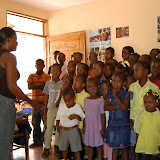
Robin and I spent our first two days in Haiti at an orphanage. We were immersed in the life of two women- a mother and her daughter- who had dedicated their lives to caring for the timoun- children- who came to them for warmth, love, and education.
Mami Kikine opened the orphanage in 1996, with the help of her energetic daughter, Madame Annie. At first they housed ten children in the village, and eventually made their way to Port-au-Prince and rented the ground floor of a home. They serve as an orphanage as well as a school of sorts; children both live in the home and come for their daily school program.
Prior to the earthquake, they had over 100 children. After the earthquake, many families sent their children to the countryside, to the promise of something better. Port-au-Prince has the highest density of any city in Haiti, which meant that post-earthquake, everything was compromised. Is compromised. Remains compromised.
So many children- timoun- were sent out to various families. Insert here a little cultural tidbit: In many- but not all- situations where a Haitian child is sent to live elsewhere, it is done so with the assumption that the child will be provided with food, clothing, shelter, medical care, and education, in return for domestic services. A live-in maid, if you will. However, in many cases, the domestic services are the only part of the bargain that is fulfilled, and the child is abused physically, psychologically, and sexually. When treated as slaves, the term for the child is “restavec”, and they are usually young females. In a country of 8 million people and climbing, 300,000 are restavecs. Food for thought.
NPR on restavecs: http://www.npr.org/templates/story/story.php?storyId=1779562
But I digress. The orphanage that we stayed at now had about 50 children during the day, and 20 at night. We spent two days with these children, and watched Mami Kikine and Madame Annie teach them their lessons through song and dance, through call and response, through dedicated sweat and love. The children crowded around the three tables- actually delaminating doors set onto table frames- and listened and learned. Shortage of chairs meant that in many situations, two chairs became seating for four with the addition of a wooden plank between the chairs. The children learned and rehearsed, sang and danced, and carefully copied their assignments into their notebooks. It was thrilling to be a part of this, to see them learning and listening, and to see them reflect our own encouraging emphasis on education with such motivation. The sweat poured off Madame Annie while she provided an entire hour of call-and-response French lessons.
The children get one MRE (military ration) per day. The MREs were previously donated, and they are running low. So when we were there, all the children got one. The next day, they confessed that they did not have enough to provide food for all the children, so they saved them for the live-in orphans, and hoped that the others were provided with enough food at home.
They sleep on the floor, girls on one side, boys on another. No mattresses, only a thin blanket between the hard concrete and their thin bodies.
The water cistern was near-empty the entire time, and yet they generously offered us daily bucket showers. Filling up one bucket took five minutes of work, and was promptly emptied again for drinking,cooking, and washing.
They are three months behind on their rent, and they have had to send other children away because they cannot afford to keep them. They have also let go of four other teachers due to a lack of funding.
But these incredible women push on, smiling the entire time, loving these children with such fierce compassion.
Robin and I brought donations from Canada. We did a tie-dye project with them and they laughed and smiled and concentrated and delighted in the results. The t-shirts were nothing like what we had expected, but they came out beautifully. We provided them with notebooks and pencils and art supplies and watched as they focused their energy into creating. We filled their water cistern and bought them new tables and chairs and clothing and food and toothbrushes and worm pills.
We gave them so much from all your donations. And yet- they gave us so much more. I wish that all of you who donated time, money, or even words to me could receive a piece of the gift that Robin and I received from the orphanage. We learned so much from the children. We learned that love is hope, and hope is our future. And children need hope to grow. We learned that life is harder there than anywhere our own children will grow up, and that the beauty comes in the children. We learned that children of all ages have something to teach you, and each other. We learned that children without parents can make you cry, but that if they are in a space of love and acceptance and learning and hope, it will be alright.
We learned so much more than we both even understand yet. I hope these photos show it, and share some of it with you. Thank you, everyone, for all your love, support, and encouragement.
Happy Canada Day, everyone. Love this place, this home, this space. We are all so lucky.


More photos from our orphanage work:
Monday, June 28, 2010
Home again, heartbroken again.

Went for a run as soon as I arrived home (hello, sweet exercise!) and I feel so lucky, so sad, so heartbroken. As per usual upon return from Ayti cheri. There is so much I take for granted in this world, so much I would give to let Ayti have forever. The fresh, moist, coastal air that fills your lungs when you step out of the Vancouver’s beautiful airport. The green of our city parks. Community gardens. The sweet, spicy scent of freshly chipped cedar. Drinking water straight out of the faucet. Homes. My home.
The ease of life.
So easy here.
And of course I came home to my garden, my fresh green peas, and found myself crying. How can it be so simple here, and so complicated in Haiti? How can I complain about the poor soil in my garden when we have an agricultural system that functions, even flourishes? How can I complain about the resources missing in our health care system after working for one day in the Port-au-Prince General Hospital?
I didn’t write a lot on this past trip. Not for lack of experiences to share, nor for lack of inspiration. Only for lack of words to describe it all. There is so much that needs to be shared, yet so few avenues to express myself that I found myself rewriting unwritten words in my head on the plane home.
Have I shared with you yet the resilience of Haitians? Haitians are the strongest people I have ever had the honour to meet. Every single one of them.
Immunizing young children is usually a screaming mess here at home. We immunized an entire orphanage and only one child cried-sniffled actually- and even then it was only one sniffle. They sat bravely in their chair, waiting to get poked in the arms with a sharp and unfriendly object, and didn’t even flinch.
A young beauty who got caught in a fight was slashed across her face and arms by broken bottles and lay silent in the stretcher while we sutured closed her lacerations.
Emaciated, tired bodies lie in the medicine ward of the General Hospital, waiting to die, and ask you only for water when you walk by them, and you are trying not to cry for the sight of it all.
A 13 year old girl who lost her entire family- four siblings and both parents- lives only with her 14 year old cousin (who also lost her family) under a tarp in a muddy camp. She comes to us daily and hopes that someone- anyone- will give her a job to do for a mere five dollars, or even one dollar. She does not ask, only waits.
Two amazing women work tirelessly all day, every day, to support an orphanage and day center for anywhere between 25 and 100 beautiful, intelligent, malnourished children. They do it out of love for the children and hope for Haiti’s future. They inspire them to grow strong and wise and share love with the world. They sing songs about children being our future. They struggle daily with how to find the funds to support these children. They can’t sleep for the stress of it all. Their water tank is empty, they are three months behind on rent, their tables and chairs are broken. But every day they wake up with smiles and lead these children through their school lessons, singing and dancing and smiling through it.
Somehow it seems so hopeless from here. But not in Haiti cheri. In Haiti you push on, past the hardships, the rains, and threat of hurricanes taking down your tarp, the sickness, the death. You push on for love, for life, for youth.
There are so many ways to fall in love. Somehow, I have fallen in love with an entire nation of people after having my heart broken so many times. I would give so much if I could only find a way....I love you, Haiti. You have broken my heart over and over and over, but I cannot forget you. Pa bliye Ayti. Mesi.
Monday, May 17, 2010
Action
Its been a week since I've been home now, and last night it caught up to me. This morning I am thinking more and more of Haiti and all there is to be done there. So much frustration on so many levels to get work done, and so much waiting around and red tape to access the funding. Food distribution (aka rice distribution) stopped in Petionville's IDP camp six weeks ago and people are going hungrier and hungrier. Political upheaval is ripe; opposition parties are calling for Preval to step down in favour of an interim government. The people are beginning to make their voices heard louder; demonstrations have begun. Rains continue. And within all this, the frustration of simply finding a hospital to admit some patients makes you want to scream with the anger and injustice of it all.
Below is the link to a video of Sean describing this frustration, when a patient arrived at our hospital with diptheria. Staff drove around the entire city with him ALL DAY trying to get him admitted and find the antitoxin, only to find out late at night that it had been locked up in a warehouse thirty minutes from our own camp. Everyone was devastated, camp morale plummeted. The next day we closed the hospital to prevent possible transmission to other patients. We immunized everyone. We cleaned, disinfected, and prayed for Oriel, the 15 year old who was an only child.
http://ac360.blogs.cnn.com/2010/05/10/video-diphtheria-epidemic-threatens-haiti/
The resources exist, with the hundreds of NGOs and humanitarians pouring in daily. We just have to get them out there, make them available, accessible. Cut the red tape. Stop the bureaucracy. Lets help Haiti rebuild their future- from scratch- NOW. Lets put words into action.
Photos uploaded below. =) Thanks for listening.
Below is the link to a video of Sean describing this frustration, when a patient arrived at our hospital with diptheria. Staff drove around the entire city with him ALL DAY trying to get him admitted and find the antitoxin, only to find out late at night that it had been locked up in a warehouse thirty minutes from our own camp. Everyone was devastated, camp morale plummeted. The next day we closed the hospital to prevent possible transmission to other patients. We immunized everyone. We cleaned, disinfected, and prayed for Oriel, the 15 year old who was an only child.
http://ac360.blogs.cnn.com/2010/05/10/video-diphtheria-epidemic-threatens-haiti/
The resources exist, with the hundreds of NGOs and humanitarians pouring in daily. We just have to get them out there, make them available, accessible. Cut the red tape. Stop the bureaucracy. Lets help Haiti rebuild their future- from scratch- NOW. Lets put words into action.
Photos uploaded below. =) Thanks for listening.
Friday, May 14, 2010
Wednesday, May 12, 2010
Bon Bagay

Leaving Ayti yet again, and it hurts yet again. Yeterday I received the most sincere thank you for all the work done here that I was moved to tears. It came from one of our staff members, an amazing man who works tirelessly for this cause. He thanked me for coming to his country to help his people, and told me that words could not express how much thanks he felt. It was so touching and heartfelt that I immediately welled up with tears. I tried to tell him that it was an honour to be here, that I am in love with the people and culture of Ayti, that their strength and resilience touches me and moves me to remember what is real and what matters in this life. That all the orphans who make their way to the clinic on their own break my heart daily, and that the very least I feel I can do is provide them with basic medical care. But words cannot express how I feel either, and so we sat in silence, thankful for each others' work. He thanked me, I cried, and I thanked him and his people.

I leave behind an entire tent city some 60,000 people strong, strengthened and empowered by our little organization. The camp has changed so much since the last time I was there; ditches and drainage systems have been dug and fortified with sandbags, bridges built, latrines improved, gravel laid down on the main streets, sandbag stairs built within the mud. No longer is it the slippery, sliding mud camp that I visited in march. JP HRO continues to work with the community and campaign tirelessly and thanklessly for the entire capital city of port au prince, and they are doing amazing work. Other NGO workers live in nice houses in ritzy parts of town, with pools and gardens and lounges. We live in tents just outside the IDP camp, more in touch with the routine of camp life, and most importantly, allowing more of our funding to go where it matters most: the people. Grassroots, aware, conscientious, and driven by fierce passion, this small organization manages one of the largest camps in the city, and does it well. Bon bagay. A la prochaine.


Tuesday, May 11, 2010
Children of Delmas


Mobile clinic to Delmas 32.
We arrive to a dusty IDP camp, pigs amid the central garbage dump, children playing beside them. There is a large white tent that sits beside the school, ready for incoming transient NGOs to provide their medical services. But the rains have washed mud through it, and school is in progress today, meaning the benches are being used.
We spend the first 20 minutes scraping mud off the floor and locating benches, chairs, lumber to create a makeshift clinic with space for patients to sit and be treated. We then walk through the camp, someone finds a loudspeaker, and we announce our presence. It promises to be busy.
This camp does not have the benefit of an NGO residing nearby, and the engineering that has been done in Petionville does not exist here. Their paths are muddy, their garbage and latrines spill out onto the main routes, and malnourished kids run around in bare feet, shouting at us "Blanc! Blanc!".


We tour the camp and return to work. It is busy, with many patients asking for the same things; something for their acid reflux, their headache, their joint pain, their itchy eyes, their diarrhea, their respiratory infections, Oh, and by the way (they add as an afterthought) they can't sleep.
The stories pour in, and before you know it I am crying for a 12 year old girl. And being hugged and kissed by a 9 year old. And trying, trying, trying, to not let the dam burst while caring for these amazing kids. It is 80% children here, and many of them come alone, without parents. So brave, so strong. Earthquake survivors, all of them. Our pediatrician takes only a five minute break all day; her lineup of patients is long and overwhelming to all of us. She works through the hunger and thirst, smiling the entire time. Amazing.


We treat 200 patients in four and a half hours. At the end we pack up and head out, exhausted, thrilled, saddenned, and deeply fulfilled in ways that can never be recreated. THIS is why we are here. THIS is why Haiti needs us. I look at the happy faces of our new volunteers and know that they too have been transformed in a few hours; they are now in Haiti. Living, breathing, working, and loving Ayti.

Monday, May 10, 2010
Tribute to Captain Barry, Robert, and Dimitri
Like the 12 year old boy today with an open wound on his head; a concrete brick had fallen on him in the earthquake and he was hit in the back of the head. Four months later and a stranger who recognized him at an orphanage brought him into our clinic. This boy lost his parents and had no one to care for him other than a distant stranger. Captain Barry happenned to be at the bedside and and we looked at each other. In that moment we both saw with so much clarity why we are here, and I knew why I continue to return. There are those that need health care and those that need so much more. They need love and hope and continued support, and I am trying my best to provide all three.
Later on a woman came to me complaining of common symptoms: cold, acid reflux, joint and back pain, headache. I adressed all these issues the usual way, and then she pulled out another one: insomnia.
Since when?
Since the earthquake.
Did you lose family?
Yes; two children.
Luckily for us, we have Robert, a psychologist, working at the moment, so I referred her to him. Half an hour later, I came back to check on her and he told me the rest of her story, with Dimitri translating.
This woman runs an orphanage of 25 children, and as luck would have it, it collapsed in the event. Now she sleeps on the streets with these 23 children (two died) and has nowhere to go. She can't sleep at night for the stress of finding food and shelter, and feels bad for not being able to sleep because it makes it harder for her to look after them. And there you have it. The psychologist looked at me and said "f*@k". Because in this world, in this reality, how do you help this woman? There is no "refer to social work", no meals on wheels, no welfare cheque she can receive. All you can do is listen. And raise awareness. And hope that by listening, you bless her with hope and some vague sense of relief that we care. These photos come from her private collection, and I share them with you in hope and solidarity.


Arrival in Ayti


Arrived safe and sound in Ayti, and it was so nice to be welcomed immediately by so many good friends. The drive to Petionville is the same; shocking scenes of crumbling buildings amid lively markets and peaceful, resilient, beautiful people.
It is Sunday, which means the hospital is slow, so a few of us went out on a tour of Port au Prince with one of our drivers. The tour was reeling and stirred a deep sorrow within us all. Our driver, Crevois, took us all over the city and then to the area where his business used to be located. It was the largest area of rubble I have seen yet in Ayti, and he moved me to tears when he pointed out what once was his community.
The building that three babies lay under.
The house where eleven people died.
The church that is now benches amid rubble, yet people come faithfully every Sunday to pray and hope for better times.
The fresh skull of an eleven year old boy, still with hair on it, visible skull fractures.
He knew each and every member of that community, including the boy, and yet he calmly pointed out these facts, at peace with them. He himself had left his shop 45 minutes before the quake hit. He lost his entire business, but luckily his family is safe.
He is one of many survivors, some by minutes, others by hours. And he is one of millions just like him, bonded to each other by survival, by being survivors. By knowing so many who didn't make it.


The house where eleven people died.
The church that is now benches amid rubble, yet people come faithfully every Sunday to pray and hope for better times.
The fresh skull of an eleven year old boy, still with hair on it, visible skull fractures.
He knew each and every member of that community, including the boy, and yet he calmly pointed out these facts, at peace with them. He himself had left his shop 45 minutes before the quake hit. He lost his entire business, but luckily his family is safe.
He is one of many survivors, some by minutes, others by hours. And he is one of millions just like him, bonded to each other by survival, by being survivors. By knowing so many who didn't make it.
Like the man who was trapped underneath rubble near the church and called his sister to tell her he was alive, could they please dig him out. But they couldn't, they did not have the capacity to move such giant pieces of concrete, and so the man died. Which is worse, I wondered: to be the trapped man or the sister, hopeless? Still alive, with such sorrow? And this is only one story, of millions.
And tonight as the rains came down hard and strong onto my face, my head, drenching every cell in my body, I thought of her; the sister. Likely huddled under a tarp somewhere, pulling it tight to keep the rain off her bed/clothing/kitchen/belongings. And like so many survivors, was she wondering "why me? Why did I have to survive?" Or was she grateful to be alive, to have the rains bring water to the (few) crops and the mango trees? To settle the dust in the air? What was she thinking? What were the sisters of fallen brothers thinking tonight?
And Crevois took us home to our own tents. And we thanked him for sharing, and he went home to his family. And we reeled. And thought. And were far more grateful than we could ever be, for so much more than can ever be written or verbalized. And there is beauty in that, if nothing else.
And tonight as the rains came down hard and strong onto my face, my head, drenching every cell in my body, I thought of her; the sister. Likely huddled under a tarp somewhere, pulling it tight to keep the rain off her bed/clothing/kitchen/
And Crevois took us home to our own tents. And we thanked him for sharing, and he went home to his family. And we reeled. And thought. And were far more grateful than we could ever be, for so much more than can ever be written or verbalized. And there is beauty in that, if nothing else.


Subscribe to:
Posts (Atom)